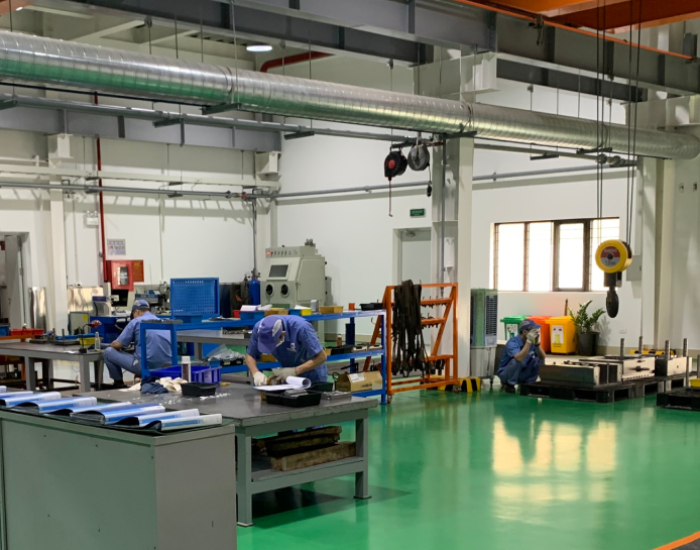


Vietnam’s steel industry has only reached 67% of production capacity because of import pressure
According to Mr. Ho Nghia Dung in 2015 and 2016, Vietnam’s steel industry has achieved a fairly high growth rate of over 20%/year, however, the steel industry has only operated with about 67% of the existing production capacity. .
Specifically, in 2016, steel billet production reached 7.8 million tons, equivalent to 62% of the industry’s designed capacity of 12 million tons; final products of all steels reached 17.7 million tons, equal to 67% of the designed capacity of 26.4 million tons; or construction steel, produced 8.6 million tons, equaling 67.7% of the designed capacity of 12.7 million tons…
However, according to Mr. Dung, the performance of Vietnam’s steel industry in the first quarter of 2017 showed signs of slowing down. Specifically, in the past 3 months, the whole country produced over 4,637 million tons, up 18.8% over the same period and steel consumption reached over 3,761 million tons, up 6.7% over the same period in 2016.
“Despite the growth in the first quarter of 2017, steel consumption growth was only 6.7% while the steel industry expects this target growth to be 12% for this year,” Dung said. We know, along with the recovery of the construction industry and the real estate market, the domestic demand for steel has increased, however, the reason the steel industry only operates at 67% of its current capacity is because competitive pressure from products of the same type imported into our country.
Accordingly, as of March 15, 2017, the amount of finished steel imported into Vietnam has reached 3.56 million tons with a turnover of 2.2 billion USD, up 13% in volume but up 64% in quantity. value of import turnover over the same period. In which, imports of color coated steel sheets reached 84,748 tons, up 40%; steel rods reached 141,009 tons, up 113%; cold rolled steel was 159,381 tons, up 158%… In addition, imports of welded steel pipes, steel wire, other galvanized steel, stainless steel… also increased very high.
“If we reduce the amount of imports, we hope to increase the production capacity of the domestic steel industry,” Dung said.
Early warning investors
According to the Vietnam Steel Association, currently many domestic steel enterprises are planning to invest in expansion, especially, many foreign enterprises, mainly Chinese enterprises, also plan to invest in construction. steel factory in Vietnam.
Through the analysis of production capacity, product consumption and domestic demand for steel, Mr. Ho Nghia Dung said that it is necessary for businesses (both domestic and foreign) to invest in new or expand production. However, Mr. Dung also warned that investment should only be made in the production of product lines that Vietnam cannot yet produce, such as billet or hot-rolled flat steel products… to form a closed production line. As for the end products, such as: galvanized steel, construction steel, …, businesses need to be very cautious before investing.
Before the news that some Chinese enterprises are intending to invest in building a stainless steel factory with a capacity of up to 300 thousand tons/year in Nhon Trach, Dong Nai province, Mr. Ho Nghia Dung said, according to data According to the Vietnam Steel Association, currently Vietnam’s stainless steel demand is about 200 thousand tons/year while the existing capacity of enterprises in Vietnam has reached over 300 thousand tons/year. exploiting only 35-70% of the designed capacity. In addition, every year, our country imports about 60 thousand tons of stainless steel on average.
“Thus, if there is an additional stainless steel factory with a capacity of 300 thousand tons/year, the output will be over 600 thousand tons/year, 3 times higher than the demand” – Mr. Dung analyzed and warned. creating an unnecessary competitive advantage for Vietnam’s steel market.
Mr. Ho Nghia Dung also said that the Vietnam Steel Association has repeatedly commented on the Vietnam Steel Industry Master Plan, which affirmed that foreign investment capital (FDI) in Vietnam has greatly supported Vietnam. much for Vietnam’s steel industry in the beginning to increase production capacity and access new technologies; modernize business administration, market